
Welcome to the Wanli Machinery Blog!
We share industry insights, equipment guides, and practical tips on construction machinery, engineering equipment, pneumatic tools, and landscaping machinery to help you make better equipment decisions.
👉 Follow Wanli Machinery on Facebook for the latest product updates, project cases, industry news, and expert knowledge. Stay connected with our global community and never miss new content.
Thank you for reading and welcome to explore more articles from Wanli Machinery!
Table of Contents
- Mini excavators are commonly classified by operating weight rather than bucket capacity or engine power.
- A 1 ton model is suitable for narrow access, gardens, greenhouses, and light trenching.
- A 1.5 ton machine provides a practical balance between compact dimensions and digging capability.
- A 2 ton mini excavator generally offers greater stability, digging depth, lifting capacity, and attachment compatibility.
- Transport limits, entrance width, ground conditions, and hydraulic requirements should be checked before choosing a model.
- The best machine is not always the largest one—it is the smallest excavator that can complete the required work safely and efficiently.
Choosing between different mini excavator sizes can be difficult, especially for first-time buyers. Two machines may look similar in photographs but deliver very different levels of digging force, stability, access, and transport convenience.
The difference between a 1 ton, 1.5 ton, and 2 ton mini excavator affects much more than the machine’s weight. It can influence which trailer is needed, whether the machine can pass through a gate, which attachments it can operate, and how efficiently it performs on demanding ground.
This guide explains the main size categories and helps contractors, landscapers, farmers, rental companies, and equipment dealers select a suitable compact machine.
What Do Mini Excavator Sizes Mean?

Mini excavators are usually classified according to their approximate operating weight. For example, a “1 ton mini excavator” generally belongs to a compact weight class around 1,000 kg, but its exact operating weight may be slightly higher or lower.
Operating weight normally includes the machine, standard bucket, fuel, hydraulic fluids, and sometimes the operator. However, calculation methods can vary between manufacturers.
Operating Weight Is Not Shipping Weight
Operating weight describes the machine in working condition. Shipping weight may exclude fuel, the bucket, optional attachments, or other removable components.
International buyers should request both figures before arranging transportation. Packing frames, spare parts, additional buckets, and protective materials can increase the final shipping weight.
Model Names Are Only a Starting Point
A model with “10,” “15,” or “20” in its name may represent an approximate one-ton, 1.5-ton, or two-ton machine. It does not guarantee an exact weight.
Always confirm the official specification sheet instead of choosing equipment based only on its model name.
Specifications That Matter Alongside Weight
Important specifications include:
- Overall width
- Overall height
- Maximum digging depth
- Maximum digging radius
- Dumping height
- Capacité du godet
- Engine power
- Hydraulic pressure and flow
- Tail-swing design
- Garde au sol
- Track width
- Auxiliary hydraulic output
These details determine whether a machine is genuinely suitable for a particular job.
Mini Excavator Size Comparison
The following table shows general differences between three popular compact excavator classes. Exact figures depend on the design, engine, boom, bucket, counterweight, and optional equipment.
| Selection factor | 1 ton mini excavator | 1.5 ton mini excavator | 2 ton mini excavator |
|---|---|---|---|
| Typical operating weight | About 800–1,200 kg | About 1,200–1,800 kg | About 1,800–2,500 kg |
| Main advantage | Maximum access and easy transport | Balance of size and capability | Greater stability and performance |
| Suitable work | Gardens, farms, greenhouses and light trenching | Landscaping, utilities and residential construction | Construction, drainage, rental and heavier excavation |
| Working space | Very restricted areas | Small to medium sites | Medium sites |
| Digging performance | Light duty | Light to medium duty | Medium duty |
| Attachment capability | Basic lightweight tools | Wider attachment selection | Better support for demanding hydraulic tools |
| Transport requirements | Usually the easiest | Moderate | Requires greater trailer and vehicle capacity |
| Ground disturbance | Generally low | Low to moderate | Moderate |
| Stability | Limited under heavy loads | Improved | Usually the best of the three |
| Typical buyer | Homeowner, farmer or small contractor | Landscaper, contractor or rental business | Professional contractor, dealer or rental fleet |
The ranges above are general selection references rather than universal specifications. Buyers should compare the actual data supplied for each model.
Understanding the 1 Ton Mini Excavator

A 1 ton mini excavator is designed for projects where access and maneuverability are more important than maximum digging performance. It can work in areas that are inaccessible to conventional excavators.
Some particularly compact machines are narrow enough to travel through garden entrances, greenhouse paths, courtyards, factory interiors, and spaces between residential buildings.
Where Does a 1 Ton Mini Excavator Work Best?
This size is commonly used for:
- Residential landscaping
- Shallow utility trenches
- Garden renovation
- Greenhouse work
- Small agricultural projects
- Fence-post and tree-planting work
- Indoor demolition
- Drainage maintenance
- Light material handling
Its low operating weight can also reduce surface disturbance on lawns and completed landscaping.
Compact Access
Width is one of the main reasons to select a one-ton model. For example, Wanli’s compact 06Q Mini Excavator has an overall width of approximately 700 mm, allowing it to enter particularly narrow working areas.
Buyers should measure the narrowest point of the site, including gates, doors, passages, pipes, walls, and overhead obstacles. Space must also be available for the upper structure and boom to move safely.
Easy Transportation
Smaller machines are generally easier to transport between residential or agricultural projects. However, transport requirements must still be calculated using the combined weight of:
- The excavator
- Trailer
- Seau
- Hydraulic attachments
- Fuel
- Spare parts
- Tie-down equipment
Local towing, licensing, and load-securing requirements must always be followed.
Limitations of a 1 Ton Model
A small machine has less counterweight and a shorter undercarriage. This can limit its stability when digging hard ground, lifting heavy objects, or working with a hydraulic breaker.
It may also complete large earthmoving projects more slowly because of its smaller bucket and lower hydraulic capacity.
When Is a 1 Ton Machine Too Small?
Consider moving to a larger model if the project involves:
- Deep drainage trenches
- Repeated heavy lifting
- Large rocks or compacted ground
- Long daily operating hours
- Large-volume excavation
- Heavy hydraulic attachments
- Sloped or uneven working areas
Choosing an undersized excavator may reduce the initial purchase price but increase labor hours and operating time.
Understanding the 1.5 Ton Mini Excavator
A 1.5 ton machine sits between ultra-compact excavators and larger professional compact models. It is often selected because it provides better performance without sacrificing too much maneuverability.
For many landscaping and residential construction businesses, this category offers a useful balance.
Balanced Size and Digging Capacity
Compared with most one-ton models, a 1.5 ton excavator generally has:
- A longer and wider undercarriage
- Greater stability
- Increased digging depth
- A larger bucket
- More engine and hydraulic power
- Better operator space
- Broader attachment compatibility
It can handle regular commercial work while still operating on sites where a full-size excavator would be impractical.
Typical 1.5 Ton Applications
Common applications include:
- Foundation preparation
- Residential drainage
- Utility installation
- Aménagement paysager
- Small road repairs
- Farm maintenance
- Pool preparation
- Light demolition
- Tree and stump removal
The machine is particularly useful when the job requires more productivity than an ultra-compact excavator can provide.
A Practical Option for Rental Companies
Rental businesses often need equipment that is easy enough for different customers to operate but capable of completing a broad range of projects.
A 1.5 ton model may serve homeowners, landscapers, plumbers, electricians, farmers, and small contractors. That versatility can improve equipment utilization across different customer groups.
Check the Actual Width
Not every 1.5 ton excavator is narrow enough for residential access. Some machines prioritize stability and operator comfort, resulting in a wider body.
Retractable undercarriages can provide narrow transport width and increased working width, but buyers should confirm how the mechanism operates and whether the published dimensions refer to the tracks being extended or retracted.
Understanding the 2 Ton Mini Excavator
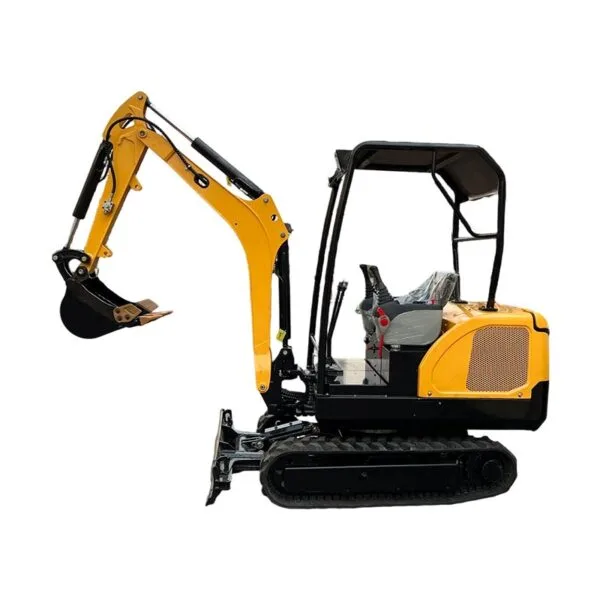
A 2 ton mini excavator is designed for buyers who require stronger digging performance and greater stability while maintaining a relatively compact footprint.
This class is commonly used by professional contractors, municipal teams, rental companies, and agricultural operators.
More Stability Under Load
The additional machine weight normally improves balance during excavation and lifting. It can also make the machine more stable when the boom is extended or when heavier attachments are installed.
However, the operator must still follow the manufacturer’s rated lifting capacities. Machine weight alone does not determine safe lifting performance.
Greater Digging Capability
A two-ton model usually provides greater digging depth, reach, bucket capacity, and breakout force than smaller machines.
These advantages can improve productivity when completing:
- Foundation excavation
- Roadside drainage
- Utility construction
- Commercial landscaping
- Small building projects
- Agricultural earthmoving
- Pipeline installation
- Concrete breaking
The larger bucket can move more material per cycle, although actual productivity also depends on operator skill, soil type, working distance, and site organization.
Better Support for Attachments
A heavier machine may provide more hydraulic capacity and stability for attachments such as:
- Briseurs hydrauliques
- Earth augers
- Grappins
- Fixations
- Seaux inclinables
- Screening buckets
- Compaction tools
- Mechanical or hydraulic thumbs
Attachment compatibility must be checked using hydraulic pressure, oil flow, attachment weight, coupler dimensions, pin diameter, and return-line requirements.
Transportation Requires More Planning
A two-ton machine may require a larger trailer and a more capable towing vehicle. The excavator’s transport width and height may also affect access to residential sites.
International buyers should confirm packing dimensions and determine how many units can fit into the selected container.
1 Ton vs 1.5 Ton vs 2 Ton Mini Excavator
The right choice depends on which performance factor is most important.
Choose a 1 Ton Model When Access Is Critical
A one-ton machine is usually the best starting point when the excavator must pass through very narrow entrances or operate on sensitive surfaces.
It is suitable for light and occasional projects where compact size creates more value than maximum output.
Choose a 1.5 Ton Model for Versatility
A 1.5 ton model is appropriate when the business completes a mixture of landscaping, residential, utility, and agricultural work.
It provides a stronger performance reserve while remaining compact enough for many restricted sites.
Choose a 2 Ton Model for Regular Professional Work
A two-ton machine is generally preferable when digging capability, stability, operator comfort, and attachment use are priorities.
It can be more productive for contractors who operate the excavator frequently and need to complete medium-duty work.
Quick Selection Table
| Your main requirement | Suggested size |
|---|---|
| Passing through the narrowest possible entrance | 1 ton |
| Light garden and greenhouse work | 1 ton |
| Occasional farm maintenance | 1–1.5 ton |
| Regular landscaping work | 1.5 ton |
| Residential utility installation | 1.5–2 ton |
| Rental to different customer groups | 1.5–2 ton |
| Greater digging depth and stability | 2 ton |
| Regular use of hydraulic attachments | 2 ton |
| Easy transport with limited towing capacity | Check 1 ton models first |
| Higher daily excavation volume | Check 2 ton models first |
How to Choose Between Mini Excavator Sizes
Weight is important, but selecting a machine based on weight alone can lead to an unsuitable purchase.
A structured selection process should begin with the project rather than the equipment catalogue.
Measure the Job Site
Record the width and height of every access point. Include the narrowest gate, door, alley, greenhouse row, or space between buildings.
The machine also needs enough room to rotate, position the blade, and operate the boom without contacting workers or structures.
Do Not Forget Ground Conditions
Wet soil, loose material, finished paving, steep slopes, and soft lawns can affect traction and stability.
A heavier machine may provide better digging stability, while a lighter model may reduce ground pressure and surface damage.
Determine the Required Digging Depth
Select a machine with a maximum digging depth greater than the actual trench requirement. A specification that only just meets the required depth may not be sufficient on uneven ground.
Boom position, bucket geometry, machine placement, and slope conditions can reduce usable working depth.
Calculate the Expected Work Volume
A small excavator can complete demanding work, but it may require more cycles and longer operating time.
Businesses should compare the purchase price with total project productivity, fuel use, labor requirements, transport cost, and expected machine utilization.
List the Required Attachments
Buyers should identify all attachments before selecting the excavator. A machine that operates a standard bucket effectively may not have enough hydraulic flow or stability for a heavy breaker or large auger.
Ask the supplier to confirm compatibility in writing.
Review Transport Capacity
Transportation can determine which machine is practical. Confirm:
- Actual operating weight
- Shipping weight
- Trailer payload
- Towing vehicle capacity
- Attachment weight
- Overall transport dimensions
- Local road requirements
Do not assume that every compact excavator can be transported using the same trailer.
Consider Operator Comfort
Operator comfort becomes increasingly important when the machine runs for several hours each day.
Seat adjustment, control layout, visibility, vibration, canopy protection, pedal space, and access to service points can influence productivity and fatigue.
Which Mini Excavator Size Is Best for Landscaping?
For narrow gardens, fence lines, and light planting work, a one-ton model may be sufficient. Its compact design helps reduce damage to finished lawns and provides access through residential entrances.
Professional landscaping companies may prefer a 1.5 ton model because it offers more power for grading, drainage, tree removal, and material handling.
A two-ton model may be more suitable for commercial landscaping, retaining walls, pond construction, and projects involving heavier materials.
Match the Bucket to the Work
A narrow trenching bucket is useful for pipes and cables, while a grading bucket helps shape ground and finish surfaces.
A larger bucket does not always increase productivity. If it is too large for the machine or ground conditions, filling it may be difficult and stability may be reduced.
Which Size Is Best for Farming?
Small excavators are widely used for irrigation, drainage, fence installation, orchard maintenance, greenhouse construction, and livestock-facility repairs.
A one-ton machine can be practical for confined agricultural areas. A 1.5 or 2 ton machine is usually better for regular ditch cleaning, earthmoving, and attachment work.
Consider Maintenance Access
Farm owners operating far from service centers should ask about filters, seals, hoses, bucket teeth, track components, and routine service procedures before purchasing.
A suitable machine should be maintainable using parts and technical support available to the operator.
Common Mini Excavator Size Selection Mistakes
Selecting Only by Purchase Price
A smaller excavator may cost less initially but take longer to complete every project. A larger machine may improve productivity but create additional transport expenses.
Compare total ownership cost rather than the quotation alone.
Ignoring the Narrowest Entrance
Buyers sometimes check the general working area but forget the gate or passage leading to it.
Measure the complete access route before selecting the machine width.
Comparing Horsepower Alone
Higher engine power does not automatically mean stronger or faster excavation. Hydraulic pressure, pump flow, bucket force, machine weight, and system efficiency also affect performance.
Buying Oversized Attachments
An attachment that is too heavy can reduce stability and place unnecessary stress on the boom and hydraulic system.
Always use tools approved for the excavator’s weight class and hydraulic specifications.
Assuming Every Machine in One Class Is Identical
Two one-ton excavators can have different widths, digging depths, engines, pumps, bucket capacities, and structural designs.
Compare complete specification sheets under consistent conditions.
Mini Excavator Buying Checklist
Before choosing a machine, confirm the following information:
- What is the actual operating weight?
- What is included in the stated weight?
- What are the transport and packing dimensions?
- Can the machine pass through the narrowest entrance?
- What is the maximum digging depth?
- What is the recommended bucket capacity?
- Which engine and hydraulic pump are installed?
- What auxiliary hydraulic flow is available?
- Which attachments are compatible?
- Does the undercarriage retract or expand?
- Are rubber or steel tracks available?
- What warranty coverage is provided?
- Which spare parts are supplied?
- Are operating and maintenance manuals available?
- Does the machine meet destination-market requirements?
- Can the supplier provide a continuous test video?
Conclusion
Understanding mini excavator sizes helps buyers select equipment based on real working conditions rather than appearance or model names.
A 1 ton mini excavator provides excellent access and transport convenience for light projects. A 1.5 ton machine offers a balanced solution for landscaping, utilities, agriculture, and residential construction. A 2 ton model provides greater stability, digging capability, and attachment potential for regular professional use.
Before ordering, compare operating weight, machine width, digging depth, hydraulic capacity, attachments, transport requirements, and after-sales support. The most suitable excavator is the one that can enter the site, complete the required work efficiently, and remain economical throughout its service life.
Buyers who need help comparing compact equipment can explore Wanli Machinery’s mini excavator range and request a configuration based on their required working width, digging depth, attachments, and destination market.
FAQ
What is the most popular mini excavator size?
The 1.5 to 2 ton range is popular among landscapers, small contractors, and rental businesses because it balances compact dimensions with practical digging performance. However, demand varies according to local transport rules and common applications.
Is a 1 ton mini excavator big enough?
A one-ton model can be suitable for garden work, shallow trenching, greenhouse projects, farm maintenance, and other light-duty tasks. It may be too small for deep excavation, heavy lifting, or high-volume earthmoving.
How deep can a 1 ton mini excavator dig?
Digging depth varies by boom design and model. Buyers should use the manufacturer’s official specification rather than relying on the weight class alone. Select a machine with additional depth capacity beyond the project’s minimum requirement.
Should I buy a 1.5 ton or 2 ton mini excavator?
Choose a 1.5 ton model when maneuverability and easier transportation are important. Choose a 2 ton model when greater stability, digging capability, operator comfort, or attachment performance is required.
Can a mini excavator fit through a standard gate?
Some ultra-compact excavators can pass through narrow garden gates, especially models with an overall width close to 700–800 mm. Measure the actual entrance and compare it with the machine’s transport width before purchasing.
Is a heavier mini excavator always better?
No. A heavier excavator may provide more stability and capacity, but it can be harder to transport and may cause more surface disturbance. The correct weight depends on site access, ground conditions, workload, and transport capacity.
What size mini excavator is best for landscaping?
A one-ton model works well for narrow residential gardens and light landscaping. A 1.5 ton model is usually more versatile for professional landscapers, while a two-ton machine may be better for retaining walls, larger drainage projects, and heavier material handling.
What information should I send a mini excavator supplier?
Provide the required digging depth, narrowest access width, ground conditions, daily workload, attachments, preferred engine, destination country, and transport limits. This information allows the supplier to recommend a more appropriate model.